Author Archives: admin

Brockenhurst Practicum 2026

The 2026 International Practicum will be held at the
Balmer Lawn Hotel, Brockenhurst, UK from Wednesday September 16th to Friday September 18th 2026.
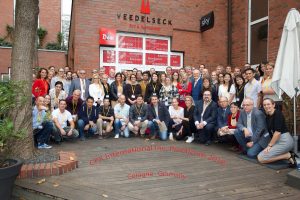
the venue for a memorable Practicum in 2017.

Convenor Professor Denny Levett

The New Forest National Park is located in south-central England, primarily in southwest Hampshire,
with a small part extending into southeast Wiltshire, near the south coast, bordered by Southampton Water
and the Solent
. It’s known for its ancient woodlands, heathlands, and free-roaming ponies, with major towns
like Lyndhurst and Brockenhurst serving as key access points.

The Speakers dinner will be held at the Pig Restaurant, also in the New Forest.


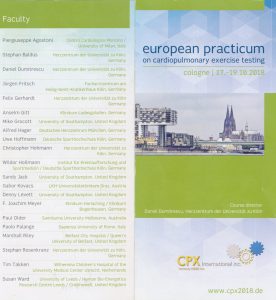
Cologne Practicum 2018

Convenor Dr. D. Dumitrescu

At that time the Board consisted of: P. Agoston i (President), M. Grocott, A. Hager, T. Takken,
D. Dumitrescu, D.Levett, M. Riley, P. Older

€2000 was made available by CPX International for the Young Investigators Award
The sponsors were Cortex, Cosmed, Scbhiller, Geratherm


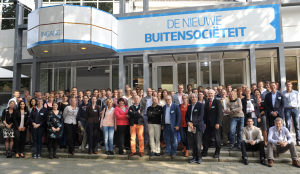
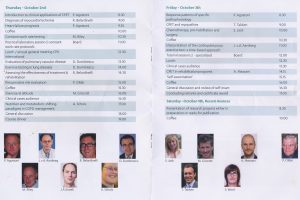
Zwolle Practicum 2014

The convenor was Dr A. Snoek

The Board at that time consisted of: P.Agostoni (President), K.Wasserman (Honary President),
R. Belardinelli,  M. Riley, D.Dumitrescu, T. Takken, A. Schols, M. Grocott, P. Older

Professor K. Wasserman did not attend the meeting.

Sponsors were: Carefusion, Cortex, Cosmed, Schiller, MGC Diagnostics


Arterial H+ regulation during exercise in humans

Karlman Wasserman, William L Beaver, Xing-Guo Sun, William Stringer

Resting arterial H+ concentration ([H+]a) is in the nanomolar range (40+/-2 nm/L) while its production is in the millimolar range/min, with little variation from subject to subject. To determin the precision with which [H+]a is regulated during exercise, [H+]a, PaCO2 and ventilation (Ve) were measured during progressively increasing work rate exercise in 16 normal subjects. (Ve) increased with [H+]a, the latter attributable to PaCO2 increase below the lactic acidosis threshold (LAT) (DVe/D[H+]a ~15 L min-1 nanomol-1). [H+]a and PaCO2 increased, simultaneously, as work rate was increased below LAT. PaCO2 reversed direction of change between LAT and ventilatory compensation point (VCP). Above LAT, [H+]a increase relative to (Ve) increase was greater than below LAT. PaCO2 decreased above the LAT, while [H+]a continued to increase. Thus the exercise acidosis was converted from respiratory, below, to a metabolic, above the LAT. We conclude that [H+]a is increased and regulated over the full range of exercise, but with less sensitivity above the LAT.

Respiratory Physiology & Neurobiology 178 (2011) 191-195

Read the entire article

Pulmonary O2 Uptake during Exercise: Conflating Muscular and Cardiovascular Responses

Brian J. Whipp, Susan A. Ward, and Harry B. Rossiter
Med. Sci. Sports Exerc., Vol. 37, No. 9, pp. 1574-1585, 2005 
For moderate-intensity exercise (below lactate threshold, thetaL), muscle O(2) consumption (VO(2)) kinetics are expressed in a first-order phase 2 (or fundamental) pulmonary O(2) uptake (VO(2)) response: dVO(2)/dt . tau + DeltaVO(2)((t)) = DeltaVO(2)((ss)); where DeltaVO(2)(ss) is the steady-state VO(2) increment, and tau the VO(2) time constant (which is within approximately 10% of tauQVO(2)). A likely source of VO(2) control in this intensity domain is ADP-mediated, for which intramuscular phosphocreatine (PCr) may serve as a proxy variable. Whether, in reality, this behavior reflects the operation of a single homogeneous compartment is unclear, however; a multicompartment structure comprised of units having a similar DeltaVO(2)((ss)) but with widely varying tau can also yield a “well-fit” exponential response with an apparent single tau. In support of this is the inverse (although poorly predictive) correlation between tau and both theta(L) and VO(2max). Above theta(L), the fundamental VO(2) kinetics are supplemented with a delayed, slowly developing component that can set VO(2) on a trajectory towards VO(2max), and that has complex temporal- and intensity-related kinetics. This VO(2) slow component is also demonstrable in [PCr], suggesting that the decreased efficiency above theta(L) predominantly reflects a high phosphate cost of force production rather than a high O(2) cost of phosphate production. In addition, the oxygen deficit for the slow component is more likely to reflect a progressive shifting of DeltaVO(2)((ss)) rather than a single DeltaVO(2)((ss)) having a single tau.

Read the entire article

Gas Exchange Responses to Constant Work-Rate Exercise in Patients with Glycogenosis Type V and VII

Hean-Yee Ong, Conor S. O’Dochartaigh, Sharon Lovell, Victor H. Patterson, Karlman Wasserman, D. Paul Nicholls, and Marshall S. Riley
Am J Respir Crit Care Med, Vol 169. pp 1238-1244, 2004 
During constant work-rate exercise above the lactic acidosis threshold, oxygen consumption fails to plateau by 3 minutes, but continues to rise slowly. This slow component correlates closely with the rise in lactate in normal subjects. We investigated if oxygen consumption during constant work-rate exercise could rise after 3 minutes in the absence of a rise in lactate. We studied five patients with McArdle’s disease, one patient with phosphofructokinase deficiency and six normal subjects. Subjects performed two 6-minute duration constant work-rate exercise tests at 40 and 70% of peak oxygen consumption. During low-intensity exercise, oxygen consumption reached steady state by 3 minutes in both groups. Lactate rose slightly in control subjects but not in patients. During high-intensity exercise, oxygen consumption rose from the third to the sixth minute by 144 (21-607) ml/minute (median and range) in control subjects and by 142 (73-306) ml/minute in patients (p = not significant, Mann-Whitney U test). Over the same period, lactate (geometric mean and range) rose from 2.68 (1.10-5.00) to 5.39 (2.70-10.00) mmol/L in control subjects, but did not rise in patients (1.20 [0.64-1.60] to 0.70 [0.57-1.20] mmol/L). We conclude that the slow component of oxygen consumption during heavy exercise is not dependent on lactic acidosis.

Read the entire article

Aerobically generated CO2 stored during early exercise

Chuang, M. L. Ting, H. Otsuka, T. et al
J Appl Physiol 87:1087-1097; 1999
Previous studies have shown that a metabolic alkalosis develops in the muscle during early exercise. This has been linked to phosphocreatine hydrolysis. Over a similar time frame, the femoral vein blood pH and plasma K(+) and HCO(-)(3) concentrations increase without an increase in PCO(2). Thus CO(2) from aerobic metabolism is converted to HCO(-)(3) rather than being eliminated by the lungs. The purpose of this study was to quantify the increase in early CO(2) stores and the component due to the exercise-induced metabolic alkalosis (E-I Alk). To avoid masking the increase in CO(2) stores by CO(2) released as HCO(-)(3) buffers lactic acid, the transient increase in CO(2) stores was measured only for work rates (WRs) below the lactic acidosis threshold (LAT). The increase in CO(2) stores was evident at the airway starting at approximately 15 s; the increase reached a peak at approximately 60 s and was complete by approximately 3 min of exercise. The increase in CO(2) stores was greater, but the kinetics were unaffected at the higher WR. Three components of the change in aerobically generated CO(2) stores were considered relevant: the carbamate component of the Haldane effect, the increase in CO(2) stores due to increase in tissue PCO(2), and the E-I Alk. The Haldane effect was calculated to be approximately 5%. Physically dissolved CO(2) in the tissues was approximately 30% of the store increase. The remaining E-I Alk CO(2) stores averaged 61 and 68% for 60 and 80% LAT WRs, respectively. The kinetics of O(2) uptake correlated with the time course of the increase in CO(2) stores; the size of the O(2) deficit correlated with the size of the E-I Alk component of the CO(2) stores. We conclude that a major component of the aerobically generated increase in CO(2) stores is the new HCO(-)(3) generated as phosphocreatine is converted to creatine.

Read the entire article

Effect of heliox on lung dynamic hyperinflation, dyspnea, and exercise endurance capacity in COPD patients

Paolo Palange, Gabriele Valli, Paolo Onorati, Rosa Antonucci, Patrizia Paoletti, Alessia Rosato, Felice Manfredi, and Pietro Serra
J Appl Physiol 97: 1637–1642, 2004.
We tested the hypothesis that heliox breathing, by reducing lung dynamic hyperinflation (DH) and dyspnea (Dys) sensation, may significantly improve exercise endurance capacity in patients with chronic obstructive pulmonary disease [n = 12, forced expiratory volume in 1 s = 1.15 (SD 0.32) liters]. Each subject underwent two cycle ergometer high-intensity constant work rate exercises to exhaustion, one on room air and one on heliox (79% He-21% O2). Minute ventilation (VE), carbon dioxide output, heart rate, inspiratory capacity (IC), Dys, and arterial partial pressure of CO2 were measured. Exercise endurance time increased significantly with heliox [9.0 (SD 4.5) vs. 4.2 (SD 2.0) min; P < 0.001]. This was associated with a significant reduction in lung DH at isotime (Iso), as reflected by the increase in IC [1.97 (SD 0.40) vs. 1.77 (SD 0.41) liters; P < 0.001] and a decrease in Dys [6 (SD 1) vs. 8 (SD 1) score; P < 0.001]. Heliox induced a state of relative hyperventilation, as reflected by the increase in VE [38.3 (SD 7.7) vs. 35.5 (SD 8.8) l/min; P < 0.01] and VE/carbon dioxide output [36.3 (SD 6.0) vs. 33.9 (SD 5.6); P < 0.01] at peak exercise and by the reduction in arterial partial pressure of CO2 at Iso [44 (SD 6) vs. 48 (SD 6) Torr; P < 0.05] and at peak exercise [46 (SD 6) vs. 48 (SD 6) Torr; P < 0.05]. The reduction in Dys at Iso correlated significantly (R = -0.75; P < 0.01) with the increase in IC induced by heliox. The increment induced by heliox in exercise endurance time correlated significantly with resting increment in resting forced expiratory in 1 s (R = 0.88; P < 0.01), increase in IC at Iso (R = 0.70; P < 0.02), and reduction in Dys at Iso (R = -0.71; P < 0.01). In chronic obstructive pulmonary disease, heliox breathing improves high-intensity exercise endurance capacity by increasing maximal ventilatory capacity and by reducing lung DH and Dys.

Read entire article